
Home / Commercial and landlord work
Commercial and landlord work
Offices, shops, salons, small industrial units and rented portfolios. The difference with commercial work is that downtime costs money, so we plan around your trading hours rather than ours.
Who we look after
Offices and studios
Heating, air conditioning and washroom plumbing, with planned maintenance so faults get found before staff report them.
Shops, salons and cafes
Hot water, heating and cooling. We work early, late or on closed days so you do not lose trading hours.
Landlords and agents
Gas safety certificates across a portfolio, scheduled together, with tenants contacted directly for access and certificates emailed the same day.
Planned maintenance
Reactive repairs are always more expensive than planned ones, and they always land at the worst moment. A maintenance contract fixes a schedule for your boilers, air conditioning and water systems, puts you at the front of the queue when something does fail, and keeps your compliance paperwork in one place rather than scattered across three years of emails.
- Scheduled servicing across all your sites
- Priority response when something breaks
- Gas safety certificates issued and tracked
- Air conditioning servicing and F-Gas records
- One point of contact, one invoice
Property managers and letting agents
We work with agents and managing companies across Surrey, and we know the parts that make your life difficult: arranging access with tenants, evidencing compliance, and getting a certificate to you before a tenancy starts rather than a week after.
We contact tenants directly to book access, we turn up when we said we would, and the certificate is with you the same day. If we cannot get in, you hear about it that afternoon rather than when the deadline has already gone.
Common questions
Do you work outside business hours?
Yes, and for most commercial customers that is the norm rather than the exception. Early mornings, evenings and closed days.
Can you handle several sites?
Yes. Multi-site scheduling with one point of contact and consolidated invoicing is exactly what the maintenance contracts are for.
Are you insured for commercial premises?
Yes, with full public liability cover. We will send the certificate and our risk assessments and method statements over before starting.
Do you invoice on account?
For regular commercial customers, yes, on agreed terms. New customers usually start on a job-by-job basis.
Where we work
We are based in Guildford and cover everything inside the orange line — thirty-one areas across Surrey and into south-west London. Tap any town to see what we do there.
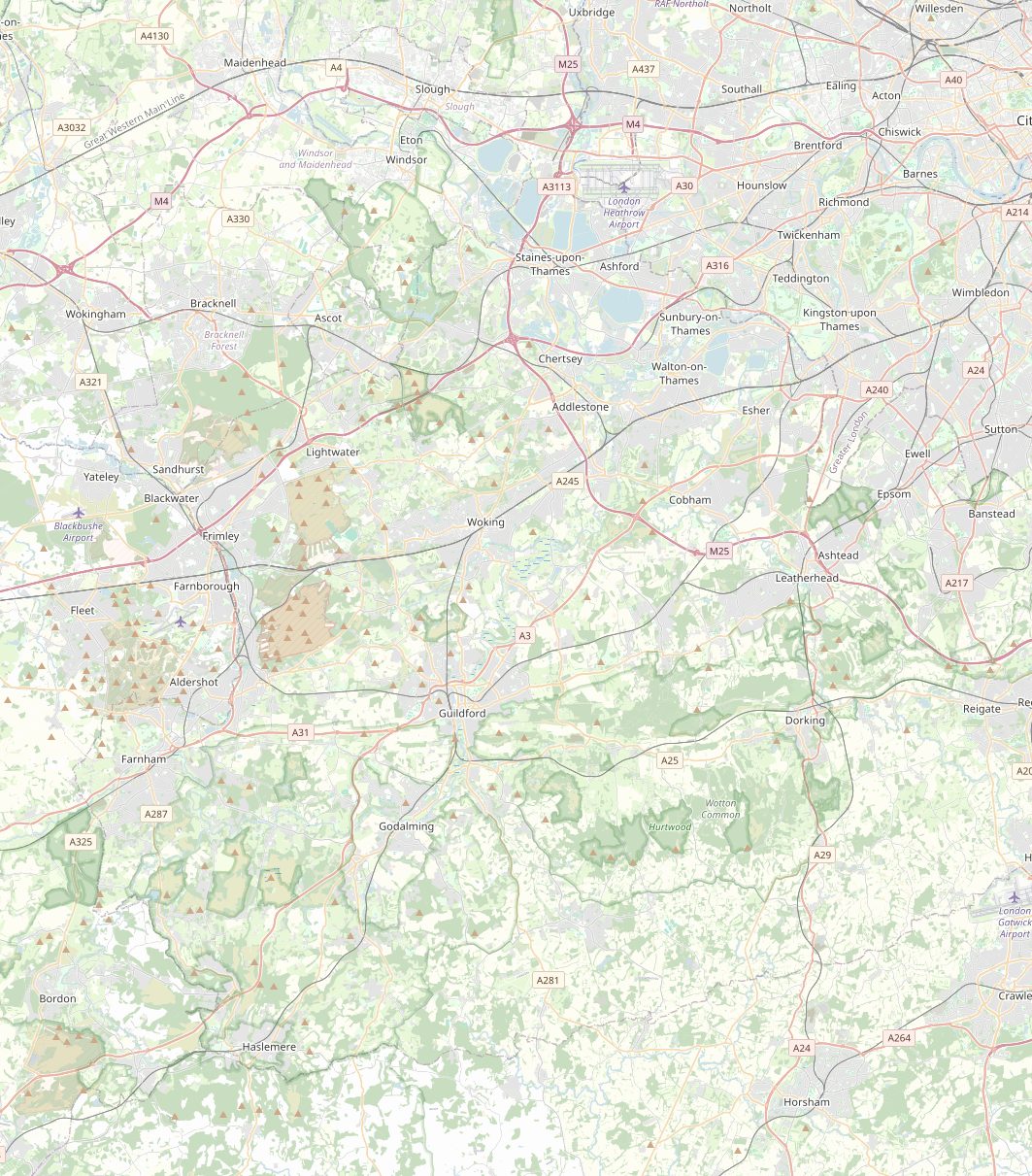
Map data © OpenStreetMap contributors
Do we cover you?
Pop your postcode in and we will tell you straight away.
Most of our work is within half an hour of the door. That is deliberate — it is why we can usually reach a breakdown the same day.
Woking and north Surrey
Mid and east Surrey
South-west London
Accredited and checked by





Commercial heating and plumbing across Surrey
Why commercial is a different job
The engineering overlaps with domestic work. The constraints do not. A domestic boiler failure is an inconvenience; a commercial one closes a business, and every hour of downtime has a number attached to it.
That changes how work is planned. We schedule disruptive work outside trading hours as a matter of course, we agree response times in advance rather than after something breaks, and we keep documentation that will satisfy an insurer or an inspector rather than merely a homeowner.
Your legal duties as a business
Commercial gas work sits under the Gas Safety (Installation and Use) Regulations, and the duties on a business are more onerous than those on a homeowner. Appliances must be maintained in a safe condition and checked by an engineer registered for the specific commercial appliance type — domestic registration is not sufficient for commercial catering equipment or larger plant.
Landlords of commercial premises have obligations to tenants. Employers have duties under health and safety legislation. And where a property has a hot water system, a legionella risk assessment is a legal expectation, with control measures and records.
We keep the paperwork that proves compliance, because in an incident the record is the first thing anybody asks for.
The sectors we work in
Offices. Comfort affects concentration, and zoning matters more than raw capacity. A meeting room with twelve people in it has a completely different heat load from the same room empty, and a system that treats them identically will satisfy nobody.
Shops and salons. Customers leave premises that are uncomfortable. In a salon it is more acute, because a heat-generating treatment area and a waiting area have opposite requirements within one space.
Restaurants and cafes. Commercial kitchens produce heat on a scale domestic work never encounters, and front of house must stay comfortable regardless. Kitchen extract and heating have to be considered together, and gas interlock requirements apply to commercial catering installations.
Care and education settings. Vulnerable occupants mean tighter temperature control, scald protection at outlets and more rigorous legionella management.
Warehouses and workshops. High volumes, poor insulation and large doors mean radiant heating is often far more effective than trying to heat the entire air volume.
Planned maintenance rather than reactive repair
The cheapest commercial heating failure is the one that never happens. A planned maintenance schedule catches the faults that cause the failures — a degrading pump, a fouled heat exchanger, a pressure vessel losing its charge — at a time you choose rather than a time you do not.
We can put a schedule in place with agreed visit frequencies and response times, and keep the records centrally so that compliance evidence is never a scramble.
Landlords, agents and multi-let property
We work with commercial landlords and managing agents across Surrey, including on multi-let buildings where access has to be arranged around several tenants. We contact occupiers directly rather than expecting you to coordinate it, and we report back in a form you can pass to a client without rewriting it.
Questions we get asked
Will you have to close my business?
Not if we plan it properly. We schedule disruptive work outside your trading hours as standard.
Do commercial gas appliances need different certification?
Yes. Commercial appliances, including catering equipment, require an engineer registered for that specific appliance type. Domestic registration is not sufficient.
Do you offer planned maintenance contracts?
Yes, with agreed visit frequencies and response times, and records kept centrally so compliance evidence is never a scramble.
Do you work with managing agents?
Yes, including multi-let buildings. We arrange access with occupiers directly rather than expecting you to coordinate it.
What is a legionella risk assessment and do I need one?
Where a business has a hot and cold water system there is a legal expectation to assess and control legionella risk, with records. It applies to far more premises than people assume.
Get a price without anyone knocking on your door
Answer a few questions and see real numbers in about ninety seconds. No sales visit needed to find out roughly what it costs.